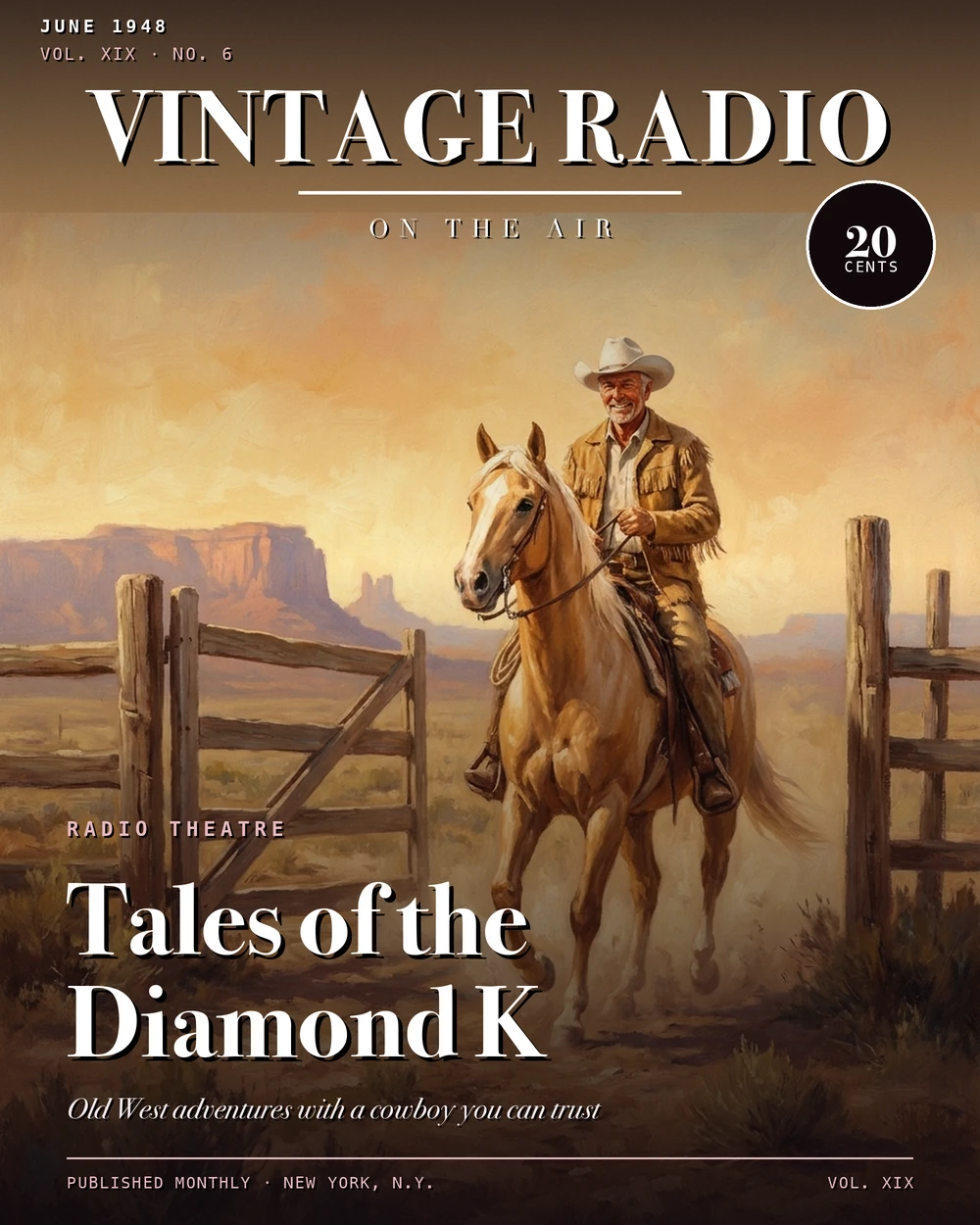
Tales of the Diamond K
The Man Behind the Microphone
By the time Ken Maynard stepped in front of a radio microphone to host Tales of the Diamond K, he had already lived several lives worth of Western adventure. Born in Vevay, Indiana, on July 21, 1895, he learned trick riding with Buffalo Bill's Wild West Show and later with the Ringling Brothers circus before Hollywood came calling. Between the early 1920s and the mid-1940s he appeared in more than 90 films, making him one of the most recognizable cowboy stars of the silent and early sound eras. He was also among the first singing cowboys, recording for Columbia Records before Gene Autry or Roy Rogers had made the style famous.
By 1944 his film career had effectively wound down, but Maynard found a new audience in radio. TCM places the debut of Tales from the Diamond K in 1951, and surviving episode file dates confirm that timing. The show was a daily 15-minute syndicated series — the kind of program local stations could drop into an afternoon slot to fill the hour before the kids came home from school. Maynard served as host and narrator, telling a different Old West story each episode. His white horse Tarzan figured in the show's promotional materials, giving the whole enterprise the feel of a personal invitation from a real cowboy rather than a studio-manufactured Western hero.
The series was syndicated by the Peterson, Schafer and Buck Agency, and sponsored by Ken Maynard Phono Records and Ken Maynard "K" Shirts — merchandise that was also pitched within individual episodes, turning each broadcast into a soft sale as well as a story.
What the Show Actually Was
Tales of the Diamond K was an anthology. There were no recurring young cowboy heroes, no ranch-hand sidekicks showing up week after week — just Maynard's voice, a new story every day, and sound effects that put the listener somewhere in the American West. The rustle of cattle and the clatter of hoofbeats carried the setting without elaborate staging. Dialogue and descriptive language did the rest.
The stories ranged widely. Some episodes followed cowboys and cattle trails; others covered rodeos, parades, and the legends of Native American cultures. A notable thread running through many titles was the lure of hidden treasure and frontier mystery — "The Unburied Treasure," "The Treasure of the Guadalupes," "The Treasure of Cuengha Pass," "The Gold of Fort Ramirez," "The Lure of El Dorado," and "The Seven Cities of Sibola" all point to a recurring appetite for lost-gold adventures and legendary riches. Others leaned toward the eerie — "The Ghost Rider of Loma Escondida" and "The Skeleton in the Well" would have landed well with any kid who liked a bit of mystery with their Westerns. "Peg Leg Smith" and "The Bryfogel Mine" hint at the kind of colorful historical figure and local legend that populated frontier storytelling, while "Posthole Bank" and "Pot 'O Gold" suggest lighter, more playful episodes alongside the grimmer treasure hunts.
The format kept things efficient. Fifteen minutes a day, self-contained, no serial cliffhangers to track. A child who missed Tuesday's episode didn't lose the thread on Wednesday, and stations could program the show with the same ease.
How Much Survived
This is where the history of Tales of the Diamond K gets genuinely striking. By most accounts, as many as a thousand episodes were produced over the course of the run — a figure that makes sense for a daily syndicated program airing for several years. Of those thousand or so episodes, fewer than 40 are known to have survived.
Available recordings were worked through and certified as a complete set on May 21, 2007, with 39 known surviving episodes compiled onto a single CD set. Despite extensive research — both online and through newspaper program logs — very little production information turned up beyond what the recordings themselves contain. No full cast lists, no detailed production records, no clear accounting of when the series ended or how many stations carried it at its peak. Syndication rather than network broadcast meant the show didn't leave the kind of paper trail a CBS or NBC program would have.
What that survival rate means, practically, is that the episode titles above represent a significant fraction of everything that still exists from the entire run. The dozen-odd treasure-hunt stories, the ghost rider episode, the skeleton in the well — these aren't a random sample of a well-documented archive. They are nearly the whole surviving record of a daily program that once reached children across the country five days a week.
Why It Worked for Its Audience
The Kids and Family genre in 1950s radio had a clear set of expectations, and Tales of the Diamond K met them squarely. Stories built around friendship, problem-solving, bravery, and honesty gave parents nothing to object to and gave children the adventure they wanted. The Wild West setting was familiar from movies, comics, and the rapidly expanding world of television Westerns, so Maynard was working with imagery his young audience already knew and liked.
What the show offered that a comic book couldn't was sound. Hoofbeats, cattle, the ambient texture of an open landscape — these details gave the stories a physical presence that print couldn't match. Radio required listeners to complete the picture in their own imaginations, and a good narrator could guide that process. Maynard, whatever his declining status in Hollywood, had spent decades embodying the Western hero. His voice carried authority on the subject in a way that a staff announcer's would not have.
The sponsorship arrangement also gave the show a personal feel. Maynard wasn't just the host; his name was on the merchandise. Ken Maynard Phono Records and Ken Maynard "K" Shirts were extensions of the same cowboy identity the show was built around. For a child listener, writing away for a "K" shirt connected the radio stories to something tangible — a piece of the Diamond K brought home.
The series found its audience at a moment when radio still held a central place in daily entertainment, competing with the early years of television rather than being displaced by it entirely. A daily 15-minute Western slotted neatly into the rhythms of a kid's afternoon, and the anthology format meant there was always something new the next day. Whatever the full thousand-episode run contained, the titles that survived suggest a show that kept finding fresh angles — legends, history, mystery, humor — rather than repeating the same story in slightly different clothes.